
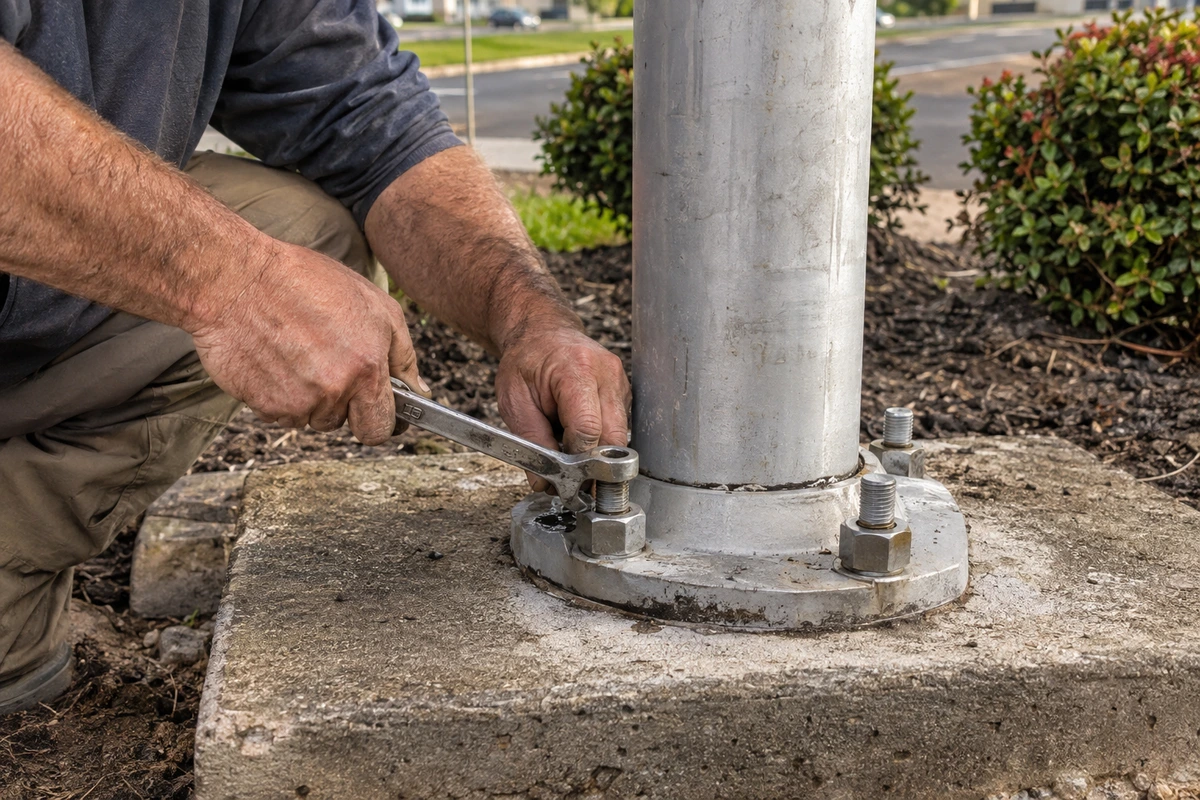
Colorado Springs Flagpole Guys provides flagpole installation and repair for homes and businesses throughout Colorado Springs and the surrounding communities. We install fiberglass, in-ground and rooftop flagpoles for front yards, storefronts, schools and office buildings. Jammed internal winches, frayed halyards, pitted finishes and leaning poles are the problems we see most, and our crews repair each one until your flag raises smoothly again. Contact us for a free quote today.
How Can You Tell a Flagpole Actually Needs Repair or Reinstallation?
The clearest sign is a pole that no longer stands plumb. Sight it against a building corner or door frame. If the top sits off to one side, something at or below grade has moved, even if the pole itself looks fine. A few other symptoms show up just as often, and each points to a different part of the system.
- Pole leaning or out of plumb at the base
- Cracked or crumbling concrete around the ground sleeve
- Rust or pitting just above the ground line
- Halyard that sticks or won't run through the top pulley
- Rope and snap hooks clanging against the pole in wind
Why Does a Flagpole Start Leaning Out of Plumb at the Base?
A lean almost always starts below grade, not in the shaft. Most ground-set poles sit in a steel or PVC foundation sleeve, packed with dry sand and locked at the top with hardwood or steel wedges under a flash collar. Over a few seasons the sand settles, the wedges shrink or work loose, and each storm rocks the pole a little further until the tilt becomes visible. The fix is usually to pull the collar, re-center the pole, repack the sand, and drive new wedges: a few hours of work, not a new pole. If the sleeve itself has shifted in its concrete footing, though, the footing has to be dug out and reset, and the job becomes a reinstallation.
Can You Just Patch the Cracked Concrete Around the Ground Sleeve?
Sometimes, but only when the crack is cosmetic. Hairline surface cracks from curing shrinkage can be sealed with a concrete patch or flexible sealant to keep water out of the sleeve. Wider cracks radiating from the pole in a starburst pattern, or a footing that has heaved or broken into chunks, mean frost or repeated wind flexing has already broken the foundation. Patching over that only hides a footing that can no longer hold the pole steady, and the lean usually follows within a winter or two. A proper repair cuts out the old concrete, checks the sleeve for damage, and pours a new footing sized to the pole's height and exposed flag area, typically extending below the local frost line.
Is Rust Just Above the Ground Line Something You Can Sand and Paint Over?
Not if there's real pitting. The band just above grade is where moisture, lawn fertilizer, and de-icing salt collect against the metal, and on painted steel poles it's where the wall thins first. On aluminum poles it shows up as white, chalky corrosion rather than red rust, often worse where the shaft sits directly against concrete or a steel sleeve without a proper liner. Light surface rust can be wire-brushed, primed, and repainted. But pitting deep enough to catch a fingernail means the wall has lost strength exactly where bending stress is highest, and that's where poles snap in high wind. A pitted base calls for replacement, and the new pole should go in with a ground sleeve and drainage so the same band doesn't corrode again.
What Makes a Halyard Stick or Refuse to Run Through the Top Pulley?
The culprit is usually the truck, the cap assembly at the top that holds the pulley. Its sheave wheels can seize from corrosion or bird debris, or a plastic sheave can crack, and once a wheel stops spinning, the halyard drags across it instead of rolling. That friction frays braided polyester or nylon rope quickly, so a sticking halyard and a snapped one are often the same problem a few months apart. Replacing the truck or its sheaves means lowering the pole or reaching the top with a bucket lift or pole climber, depending on height, and the halyard is normally replaced at the same time. On revolving trucks, a seized bearing also keeps the flag from swinging with the wind, so it wraps around the pole and the fabric wears out.
Will Swapping in a New Rope Stop the Clanging Against the Pole?
Rarely on its own. The noise comes from a slack halyard and metal snap hooks swinging into the shaft, and a new rope stretches and goes slack just like the old one. The real fixes are keeping the halyard snug and tied off at the cleat, adding vinyl snap covers or switching to coated snaps, and fitting a halyard flag or retainer ring that holds the rope off the pole. For a permanent answer, many owners convert to an internal halyard, which runs the rope inside the shaft to a locking access door. That eliminates the noise and keeps the flag from being stolen. Whether a pole can be converted depends on its diameter and wall design, so we check it during the truck inspection.
How Much Does Flagpole Installation and Repair Cost in Woodmoor, CO?
Flagpole installation and repair in Woodmoor, CO typically costs $270 to $3,549. A halyard replacement or re-wedged base sits at the low end, and a new pole set in a fresh concrete footing lands at the top. Most of the price comes down to pole height and wall thickness. It also depends on whether the old footing has to be broken out and how deep the new one must go to get below the local frost line. On taller poles, reaching a seized truck with a bucket lift or a climber adds labor too.